
Google Ads captures buyers who are ready. Meta Ads reaches buyers who will be ready. Here’s an honest breakdown of how both platforms work for real estate — and how to use them together for stronger results.
You're Running Ads. But Are You Running the Right Ones?
Every real estate developer, builder, or property consultant running digital campaigns faces the same question at some point: should the budget go into Google Ads, Meta Ads, or both?
It’s not a simple answer. And anyone who tells you one is definitively better than the other without understanding your project, your audience, and your goals — isn’t giving you useful advice.
What this blog does is break down how each platform actually works for real estate, where each one wins, where each one falls short, and how to think about using them together.
How Google Ads Works for Real Estate
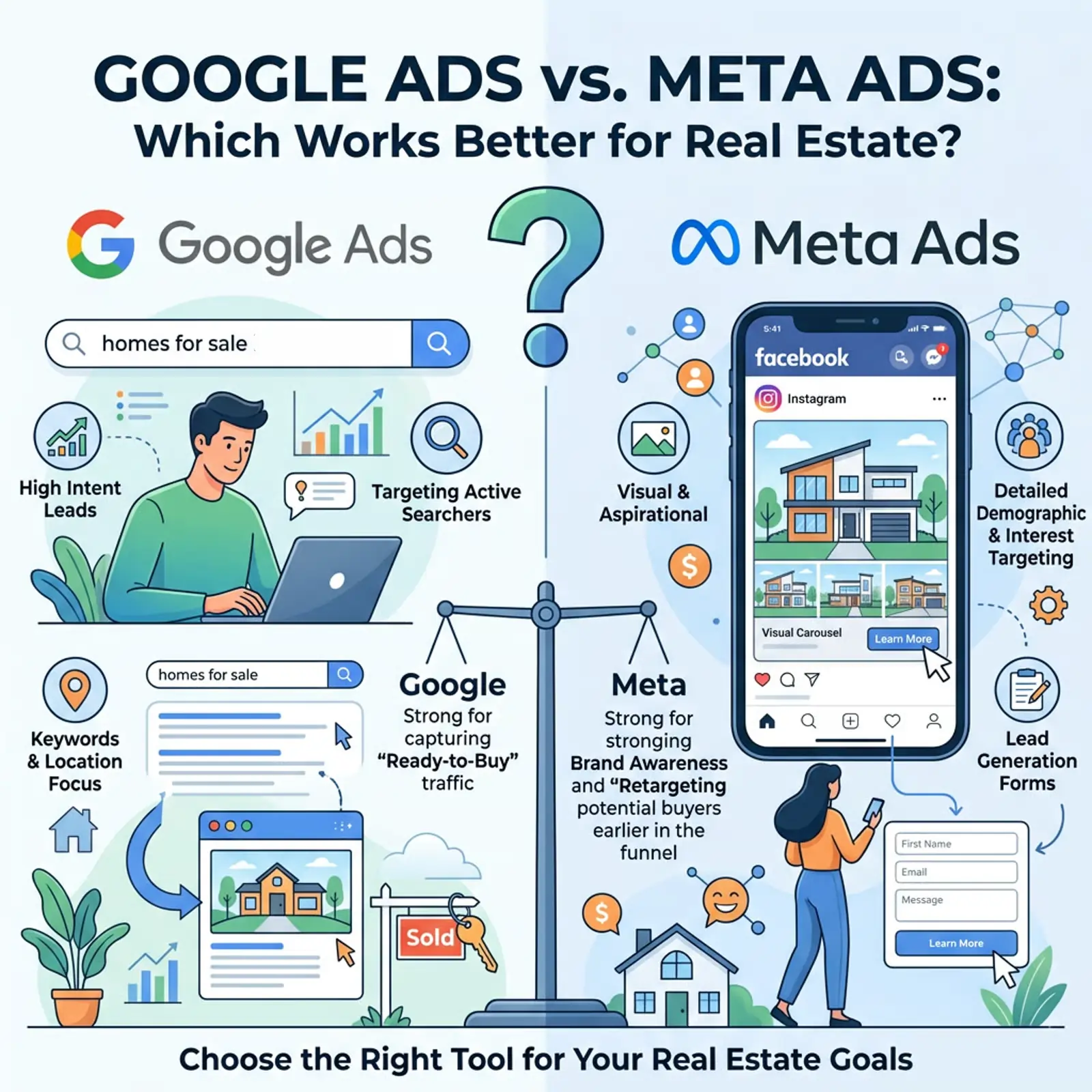
Google Ads operates on intent. When someone types “2 BHK flat under 80 lakhs” or “commercial office space for rent,” they are actively looking. They have a need, a rough budget, and a buying window. Your ad appears at the exact moment they are searching.
This is called search intent targeting — and it’s powerful.
For real estate specifically, Google Ads works well because:
- Property is a high-consideration purchase. Buyers research extensively before taking action.
- Search queries reveal where a buyer is in the journey — “what is RERA” is early-stage, “ready-to-move flats in Sector 62” is late-stage.
- Late-stage, high-intent searches convert at significantly higher rates than cold audiences.
Where Google Ads Wins
Quality of leads. A person searching for your exact project type in your location is far more likely to be a genuine buyer than someone who saw your ad while scrolling through their feed.
Lower sales cycle friction. Intent-driven leads already want what you’re offering. Your sales team spends less time educating and more time converting.
Measurable ROI. Google Ads gives you clear data — cost per click, cost per conversion, which keywords drive enquiries, which don’t.
Where Google Ads Falls Short
Search volume limits. Not every project has enough people actively searching for it. A new launch in an emerging micro-market may have very low search volume — meaning Google Ads alone can’t scale your lead pipeline.
Higher cost per click. Real estate keywords are among the most competitive on Google. Cost-per-click can be steep, especially in metro markets.
No visual storytelling. Google Search Ads are text-only. You cannot show your project’s amenities, design, or lifestyle through a search ad.
How Meta Ads Works for Real Estate
Meta — Facebook and Instagram — works on interest and behaviour targeting. You’re not capturing existing demand. You’re creating it.
Someone scrolling through Instagram isn’t searching for a flat. But if they match your buyer profile — the right age group, income bracket, life stage, and interest signals — your ad interrupts their feed and plants the seed.
This is called demand generation, and it works very differently from search.
Where Meta Ads Wins
Audience scale. Meta’s targeting depth is unmatched. You can reach people based on location, income indicators, life events (recently married, new job), and behavioural signals — at a scale Google Search simply can’t match.
Visual creative. Real estate is a visual product. Meta lets you show walkthroughs, drone footage, testimonials, project progress videos — content that builds emotional connection and trust before a buyer even visits your site.
Lower cost of reach. Compared to Google, Meta generally offers lower CPMs (cost per thousand impressions), making it efficient for awareness and top-of-funnel activity.
Remarketing power. Meta excels at staying in front of people who’ve already shown interest — visited your landing page, watched your video, engaged with a previous post. This warm audience converts at much better rates than cold traffic.
Where Meta Ads Falls Short
Lower purchase intent. The core limitation — people on Meta are not actively looking to buy. You’re interrupting, not answering. Lead quality from Meta tends to be lower because of this.
Lead nurturing required. A Meta lead often needs more follow-up, more touchpoints, and more time before converting. Your sales process needs to account for this.
Creative fatigue. Meta audiences burn through creative quickly. If you run the same ad for too long, performance drops significantly. You need a consistent pipeline of fresh content.
Head-to-Head: Real Estate Comparison
| Factor | Google Ads | Meta Ads |
|---|---|---|
| Lead Intent | High | Low to Medium |
| Lead Volume | Limited by search volume | High |
| Cost Per Click | Higher | Lower |
| Visual Storytelling | No | Yes |
| Audience Targeting | Keyword-based | Behaviour & interest-based |
| Best For | Late-stage buyers | Awareness + remarketing |
| Sales Cycle | Shorter | Longer |
So Which One Should You Use?
Here’s the honest answer: neither platform alone is enough.
Google Ads brings you the buyers who are ready. Meta Ads brings you the buyers who will be ready. A real estate marketing strategy that relies only on one is leaving leads on the table.
The most effective approach — and what consistently works for serious property campaigns — is a layered structure:
Meta Ads at the top: Build awareness, generate interest, collect warm audiences. Show project videos, amenities, lifestyle content. Let people discover you.
Google Ads in the middle: Capture buyers who are actively searching. Intercept high-intent queries with specific, relevant ad copy and dedicated landing pages.
Meta Remarketing at the bottom: Re-engage people who clicked, visited, or enquired but didn’t convert. These warm leads are your highest-converting segment and often the most overlooked.
This is not about spending more. It’s about spending in the right sequence, on the right audience, with the right message at the right stage.
A Practical Starting Point
If your budget is limited and you have to choose one to start:
- New project launch with no existing audience → Start with Meta Ads to build awareness and collect data.
- Established project with clear buyer profile → Start with Google Ads to capture existing demand.
- You have some budget flexibility → Run both, but keep Meta focused on video and remarketing, Google focused on high-intent keywords only.
At LemonTalks, the campaigns that deliver the strongest results almost always combine both platforms — with each doing the job it’s actually built for.
The Platform Isn't the Strategy. The Strategy Is the Strategy.
Google Ads and Meta Ads are tools. What determines whether they work for your real estate project is how they’re set up, what they’re targeting, what they’re sending people to, and how your sales team follows up.
A well-structured campaign on either platform will outperform a poorly structured campaign on both.
If you’re reviewing your current ad setup and want to understand where your budget is being wasted — that’s usually the right place to start.
LemonTalks runs performance-focused Google and Meta campaigns for real estate developers and property consultants. If you want a clear picture of what’s working and what’s not in your current setup, get in touch.